Professional Recap 2025
My work in Product and Complex Systems: applied learnings, method, and impact

In 2025, I worked on a system used daily by public institutions, where imprecise decisions, incomplete data, or failures in understanding can generate significant operational and legal consequences.
Working in this context led me to adopt a deliberately conservative stance in product decisions. I prioritize predictability, consistency, legibility, and safety before any aesthetic gains or formal innovation.
As a Product Designer, my focus was on making the product clearer, more predictable, and more reliable for its users, especially in sensitive activities such as case monitoring, hearings, procedure-to-process conversion, and the use of integrations with external systems.
My work was less about isolated interface execution and more about understanding problems, explicitly defining decision criteria, and organizing the product systemically to sustain good decisions over time.
In an environment pressured by feature delivery and paid demands, this requires constant attention to prioritization and, above all, de-prioritization. It means maintaining a clear vision of where the product needs to go and defending real user needs in the face of scope reductions and technical constraints.
1. Visibility and data-informed decision-making
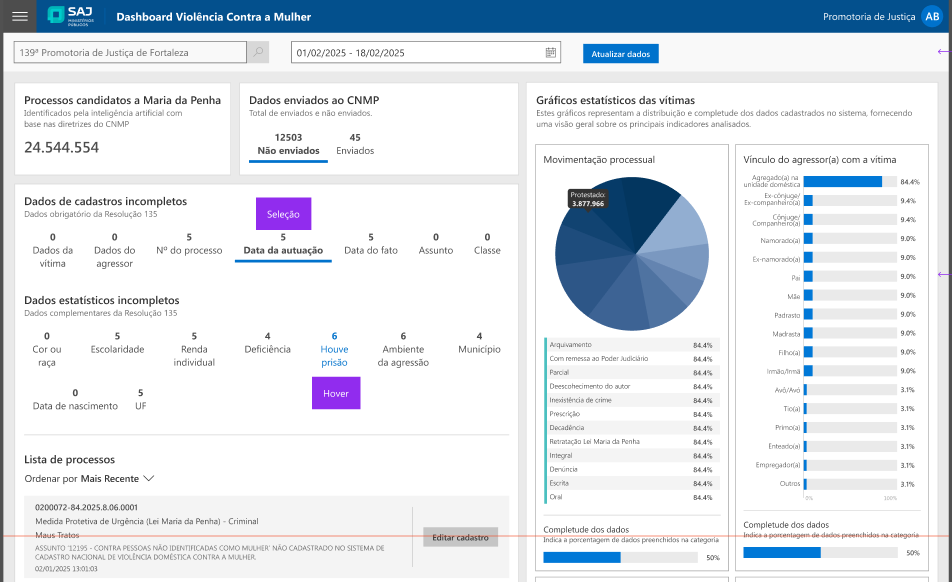
I participated in the conception of the Maria da Penha Dashboard, an initiative aimed at bringing the full journey from the previous system into the new one, allowing Prosecutors to monitor cases categorized as domestic violence against women, under the Maria da Penha Law, in a centralized, reliable, and consistent way.
The core problem was the lack of clear and consolidated visibility into these data. Existing visualizations lacked accessibility, and the information was not consistently used by system users, which hindered both case monitoring and the statistical analysis required for institutional action.
The work involved research with different user profiles, extensive review of regulations related to data reporting, studying the system’s information architecture to accommodate the dashboard, defining relevant indicators aligned with institutional standards, and ensuring the display of statistical and registry data such as location of aggression, relationship to the aggressor, existence of arrest, and identification of incomplete records.
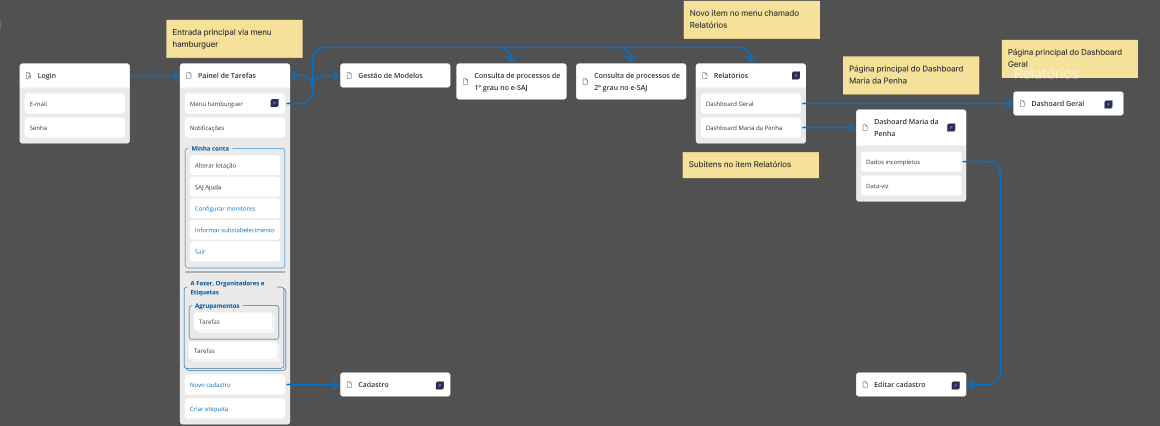
The interface was grounded in the previous system’s structure, used as an initial reference to preserve well-established mental models in a sensitive domain. From there, we carefully filtered which interactions made sense to evolve in the new product, based on real usage and users’ practical perceptions.
Beyond accessible data visualization, the dashboard also highlights data inconsistencies and enables redirection for correction, contributing to continuous data quality improvement and strengthening its use in public policy support.
2. Operational predictability in critical flows
I planned and conducted qualitative research with Prosecutor’s Offices across different states to deeply understand how extrajudicial hearings and the conversion into judicial processes work in practice.
User interviews followed a structured UX research process (planning, recruitment, script, and execution). Open-ended, topic-focused questions were designed to understand workflows and user pain points, generating insights that informed flow design and solution proposals.

The interviews revealed recurring issues such as dependency on external tools, integration failures, and difficulty prioritizing tasks. Based on these learnings, I mapped the complete user journey, identified critical dependency points between systems (calendar, Teams, recordings, documents, and notifications), and defined solution principles aimed at increasing predictability.
In critical flows, my primary criterion is to eliminate ambiguity, reduce interaction and information complexity, and make the intent and consequences of each step explicit.
Interfaces were grounded in user needs, which also created space for innovation, including the proposal of AI and automation in the most burdensome steps of the workflow.
3. Integration clarity and trust-building
I also worked on diagnosing recurring issues in integrations with court systems, based on analyses and conversations with support teams at different levels.
Evidence showed that users often attributed failures to the product when, in practice, they were caused by external instabilities, such as the inability to file petitions, receive notifications, or access case files. We triangulated interview findings with Nielsen’s heuristics for complex systems, which brought confirmation and clarity on where focus and attention were most needed.
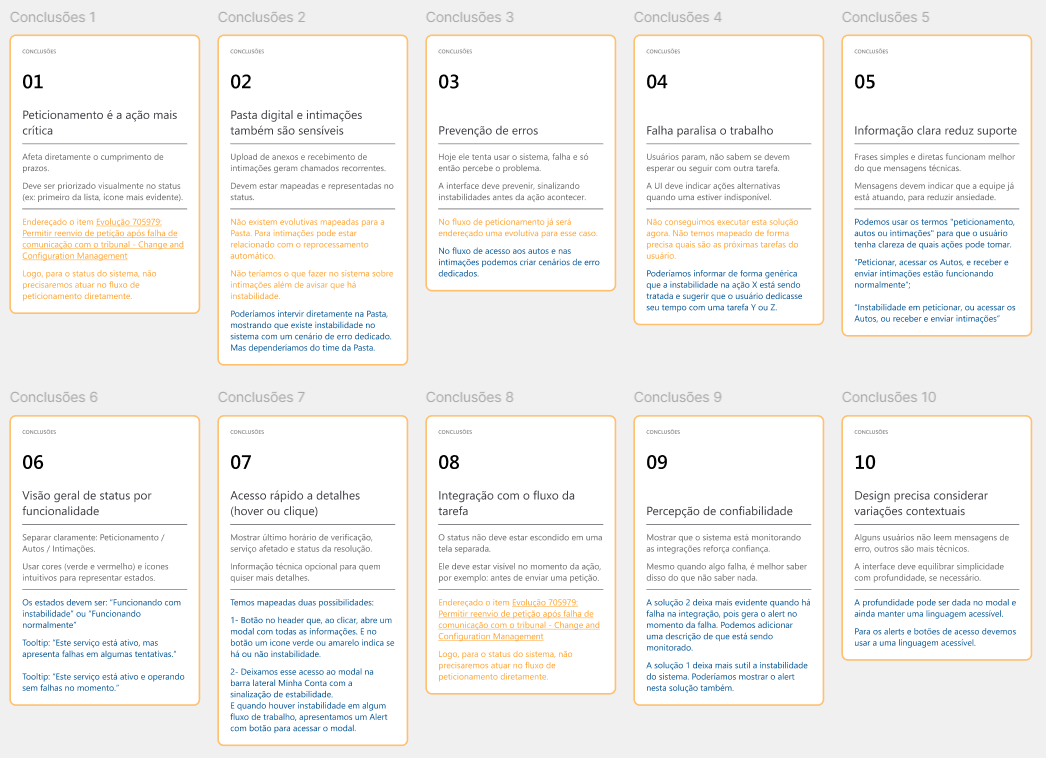
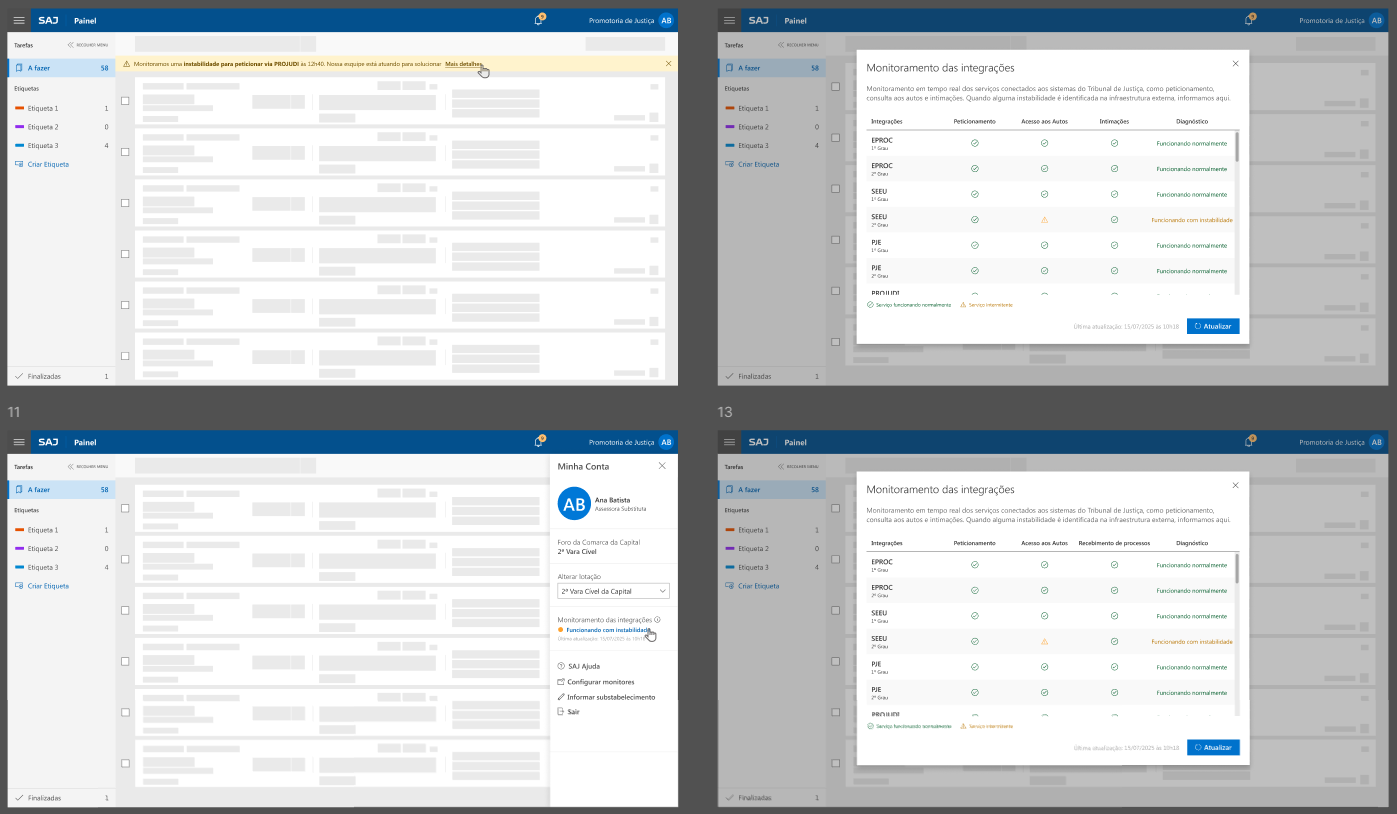
Based on this, we defined product and interface criteria to display real-time integration health with court systems, using accessible language and automatic updates.
The goal was to make the source of failures explicit before user action, through an instability panel, reducing unnecessary support tickets, increasing trust in the system, and improving the perception of stability.
4. Usability heuristics applied to complex systems
I have consistently used NN Group UX foundations as a guiding reference. Following the integration status initiative and heuristic-based data triangulation, the topic gained strong traction within the team. As a result, I prepared and presented internal material on usability heuristics applied to complex systems, based on Nielsen Norman Group references.
The presentation discussed how classic heuristics must be interpreted and adapted when applied to regulated, highly integrated complex systems. Drawing from NN/g articles, I addressed the challenge of designing products for users who are domain experts, whose work must be optimized while preserving domain complexity without transferring that complexity to the interface.
I used concrete product examples to demonstrate how principles such as system status visibility, error prevention, and continuous feedback contribute to making the system more understandable, safe, and reliable.
The goal was to establish a shared understanding between design and product around quality criteria applicable to this type of context.
5. Qualitative data triangulation and CSAT
CSAT is applied to all system users, collecting a quantitative score and an open-ended comment. In this work, CSAT was not treated as an isolated product metric but as a complementary input within a structured qualitative analysis. Numeric scores were de-prioritized to avoid simplistic interpretations based on averages or isolated fluctuations, and the focus was placed exclusively on textual comments as large-scale usage reports.
Before analysis, we aligned on the nature of these data, considering differences in context, origin, recurrence, and expectations among users who comment spontaneously. The comments were then carefully and systematically reviewed and treated as units of meaning, from which reported problems, recurring events, and perceived frictions in daily use were identified.
These reports underwent thematic categorization and were analyzed through the lens of usability heuristics, allowing us to identify consistent patterns of violations related to predictability, system status visibility, user control, and error prevention. In this context, CSAT functioned as an additional analytical layer, helping validate patterns already observed qualitatively and interpret perception shifts associated with concrete product factors such as integration instability, flow breakdowns, or lack of operational predictability.
From this qualitative triangulation, the work focused on proposing minimum viable deliveries capable of generating perceptible gains for users, acting directly on existing system issues. CSAT thus operated as a continuous listening mechanism, bringing clarity to where the product failed in practice and strengthening prioritization decisions grounded in qualitative evidence rather than isolated metrics.
6. Systemic coherence and product evolution
I contributed to the study and evolution of a new product homepage, conceived as a strategic panel to support Prosecutor’s Office management.
The proposal aimed to organize operational information and relevant indicators in a clear, updated, and decision-oriented manner, reducing unnecessary navigation and enabling quick understanding of the unit’s status.
In parallel, I participated in the final design stage of the extrajudicial-to-judicial procedure conversion flow, balancing legal rules, technical constraints, and systemic coherence, with a focus on ensuring predictability, continuity of experience, and user safety at a critical moment of institutional work.
7. Digital Business education
I completed an MBA in Digital Business focused on strategy, product, and digital transformation, deepening my knowledge in digital business models, monetization, platforms, user behavior, and data-informed decision-making. This MBA represented a meaningful expansion not only of my technical repertoire but also of my professional direction, strengthening my role as a product designer and broadening my strategic understanding of how product, design, and business connect in practice. Throughout the program, I moved beyond traditional design boundaries, seeking a deeper contribution to both product and business development.
My final thesis investigated Digital Creative Content, Monetization, and Communities from the user’s perspective, using an empirical and applied approach. The research identified patterns in content valuation, direct financial support behaviors, and motivations linked to perceived relevance, inspiration, and emotional connection with creators. It also revealed recurring barriers such as expectations of free access, low perceived value, and platform distrust.
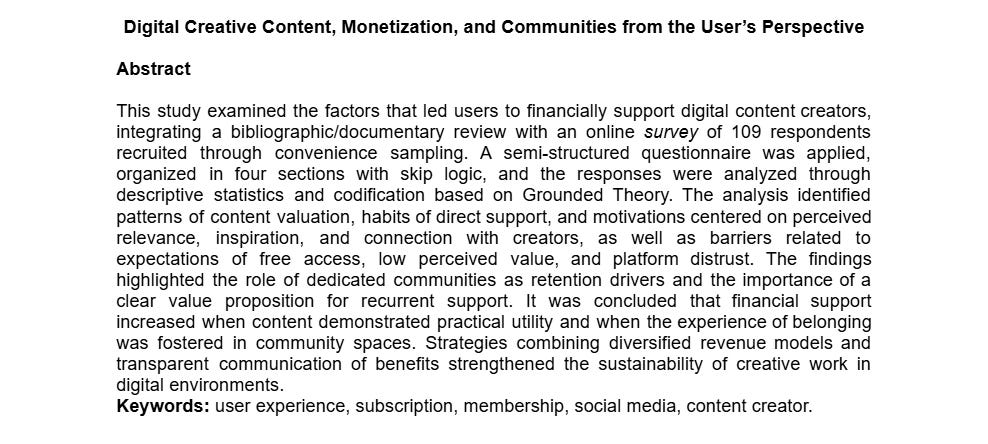
The findings highlighted the role of dedicated communities as strong retention drivers and the importance of clear value propositions for recurring support. Financial support proved more consistent when content demonstrated practical utility and when a genuine sense of belonging was cultivated within communities. Strategies combining diversified revenue models with transparent communication were shown to be essential for the long-term sustainability of creative work in digital environments.
The work was approved with the highest grade (10) and received a nomination for Best Thesis of the program. The evaluation committee highlighted the relevance of the topic, methodological coherence, empirical and applied nature of the study, and the significance of its findings. The presentation was assessed as clear and objective, with strong oral articulation, and the paper was recommended for submission to an academic conference.

Synthesis
Throughout 2025, my work reinforced a personal conviction: in complex systems, clarity in integrations, intentions, information, and in how product work is done is a form of institutional responsibility. It reduces error margins and protects users in contexts where failures are not merely inconvenient but operational and legal.
This conviction is not only technical, but ethical. By closely observing the daily routines of prosecutors, public servants, and teams dealing with sensitive decisions, it became clear that a confusing system transfers an unnecessary burden onto people.
Product design amplifies a system’s impact when it organizes information strategically, reduces ambiguity, and supports safer, more consistent, and more reliable decisions over time. I prefer institutional products that reduce the decisions and complexities already present in users’ work, rather than creating new ones.